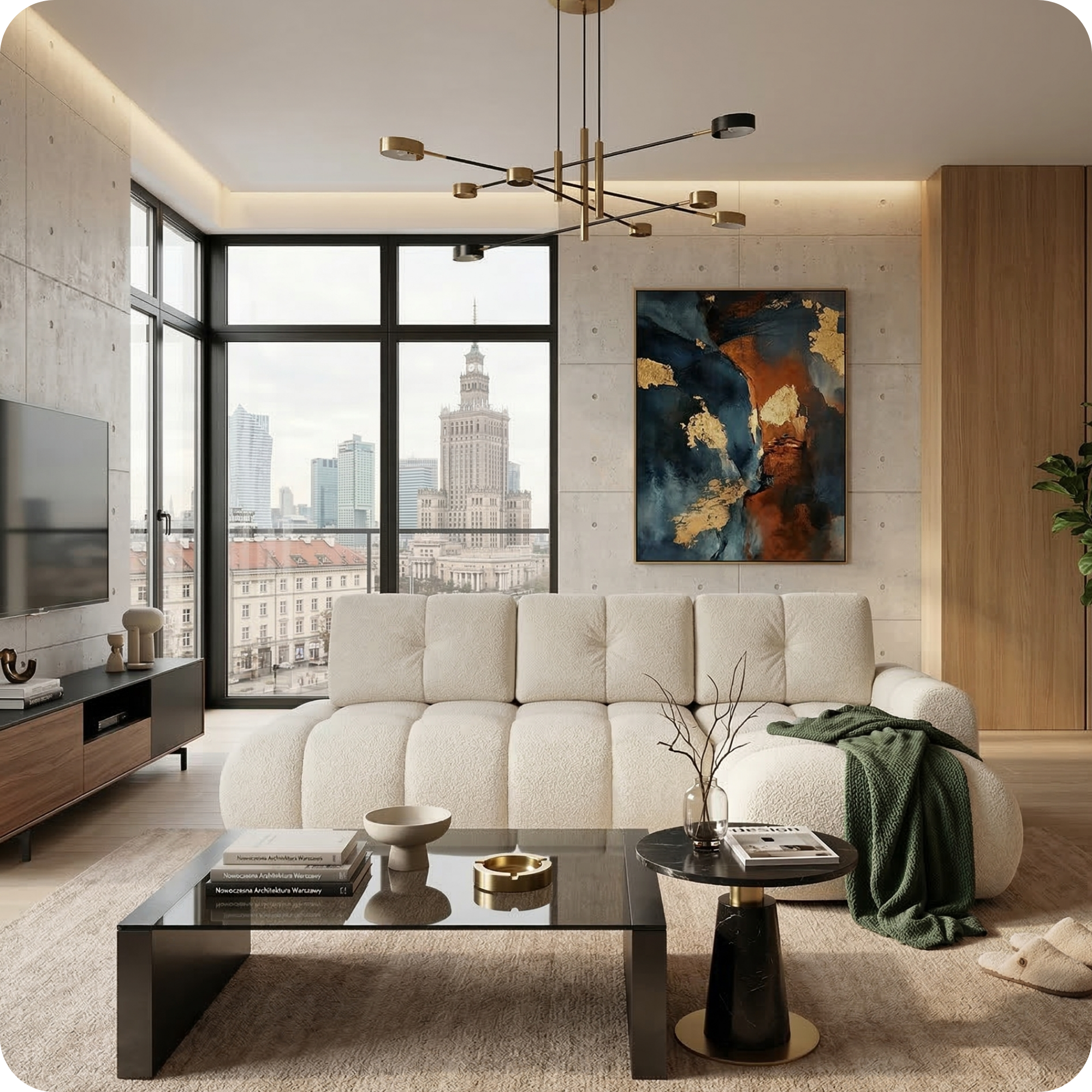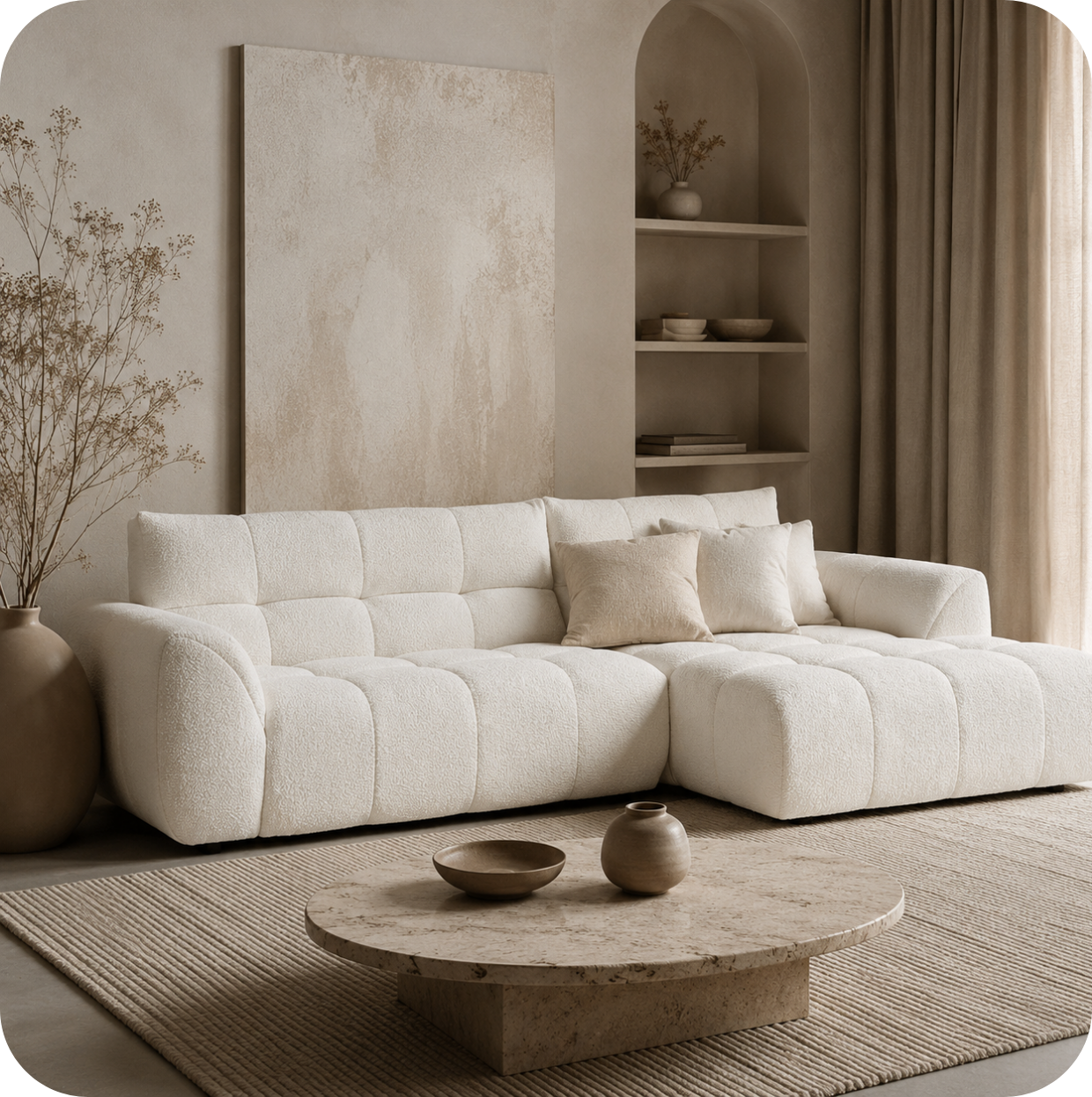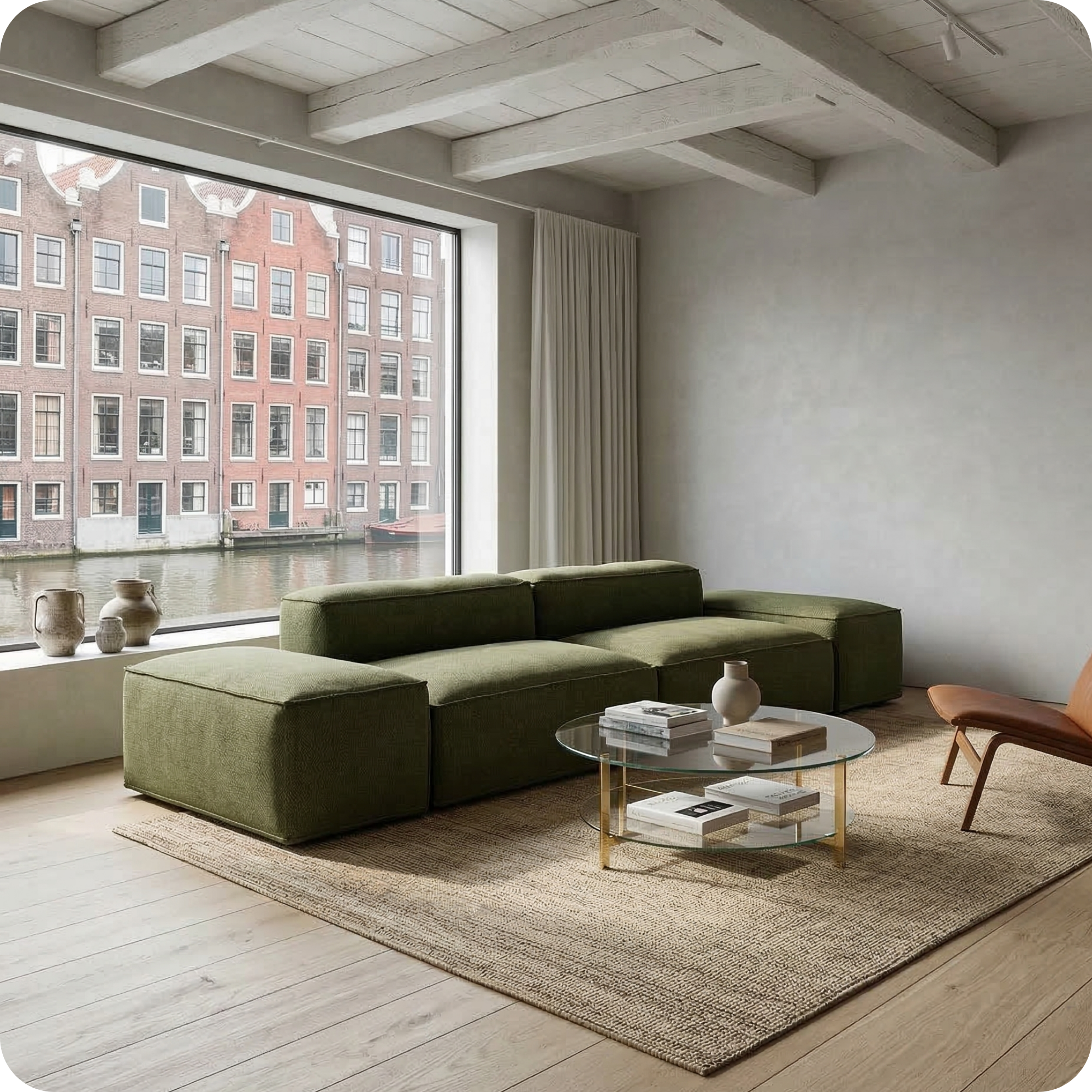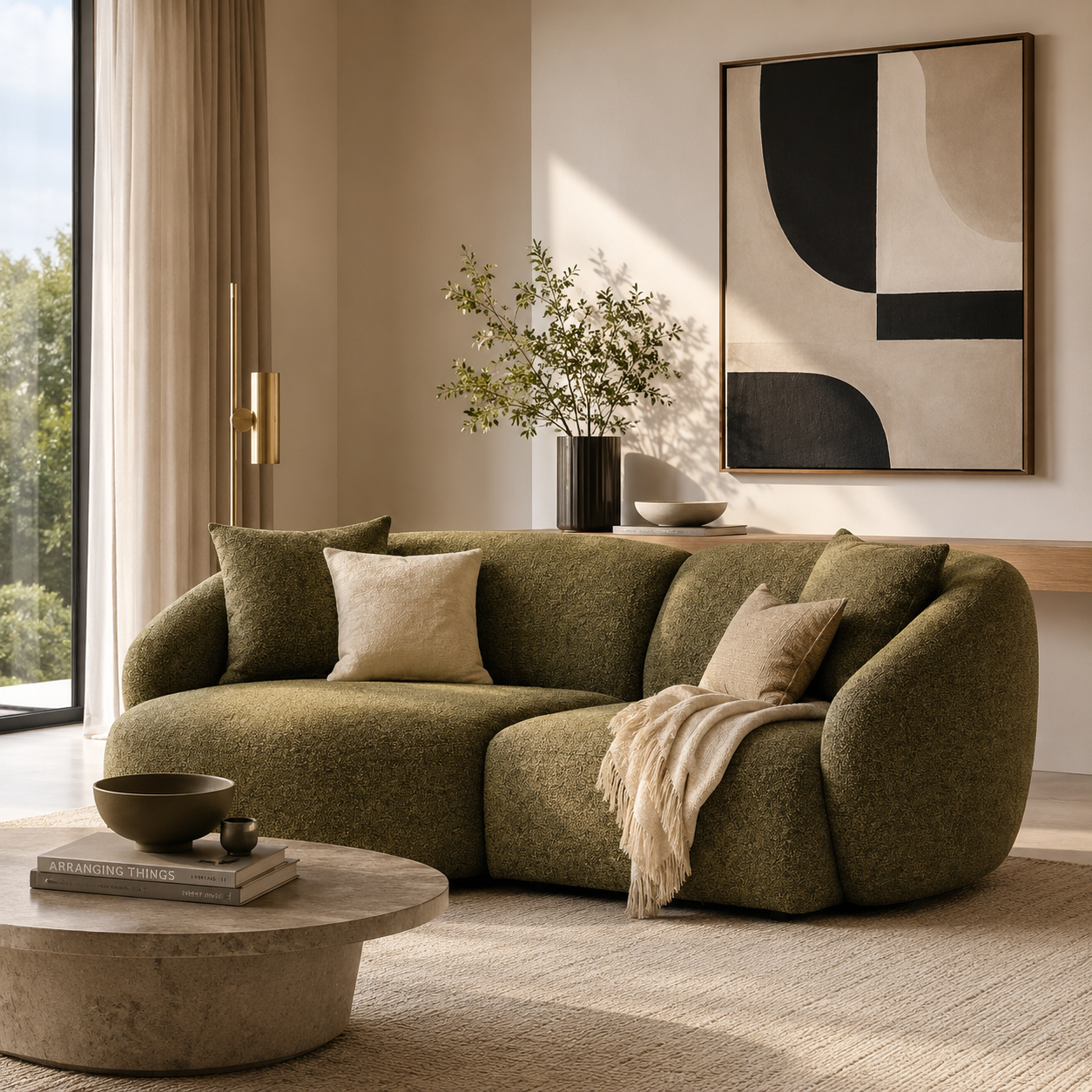

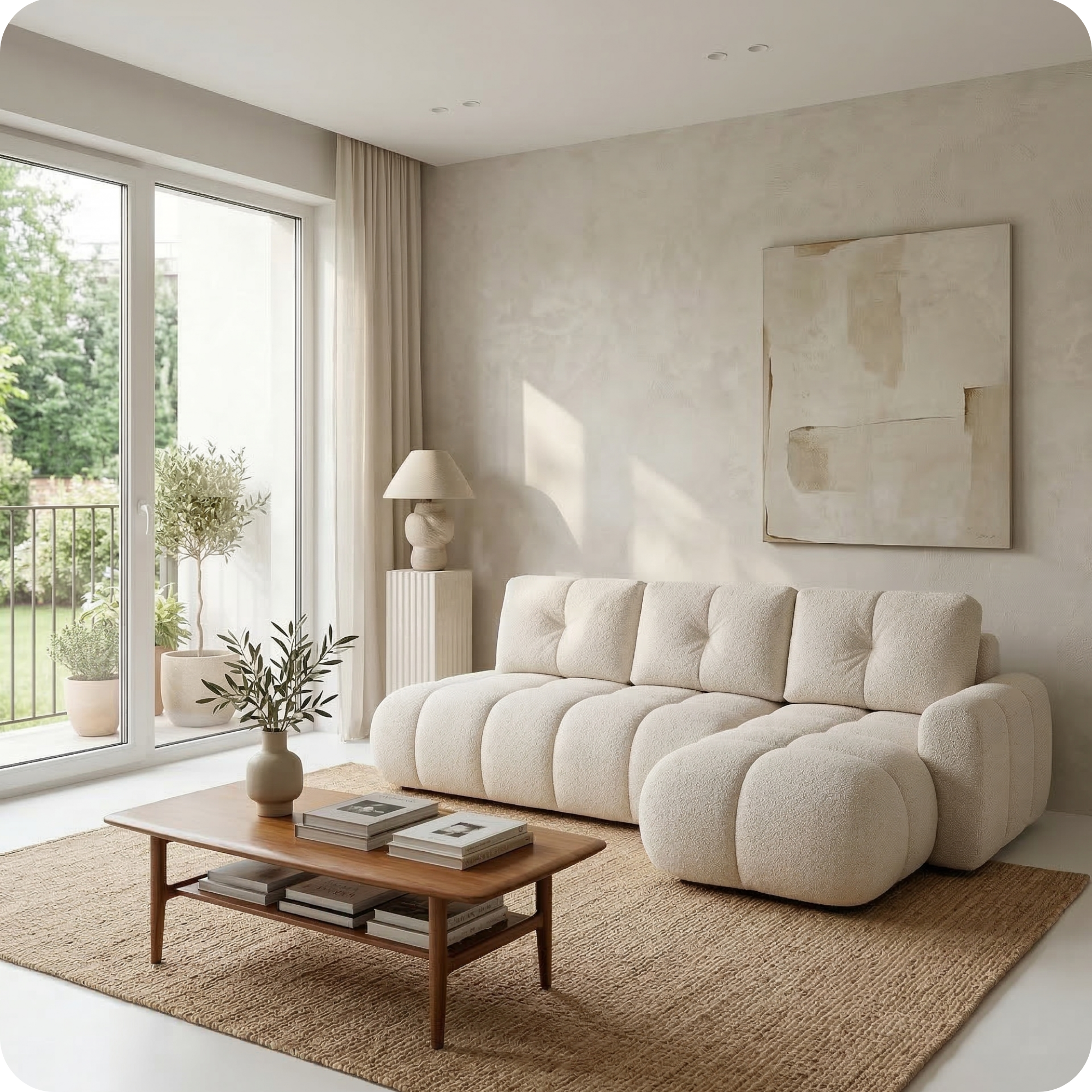

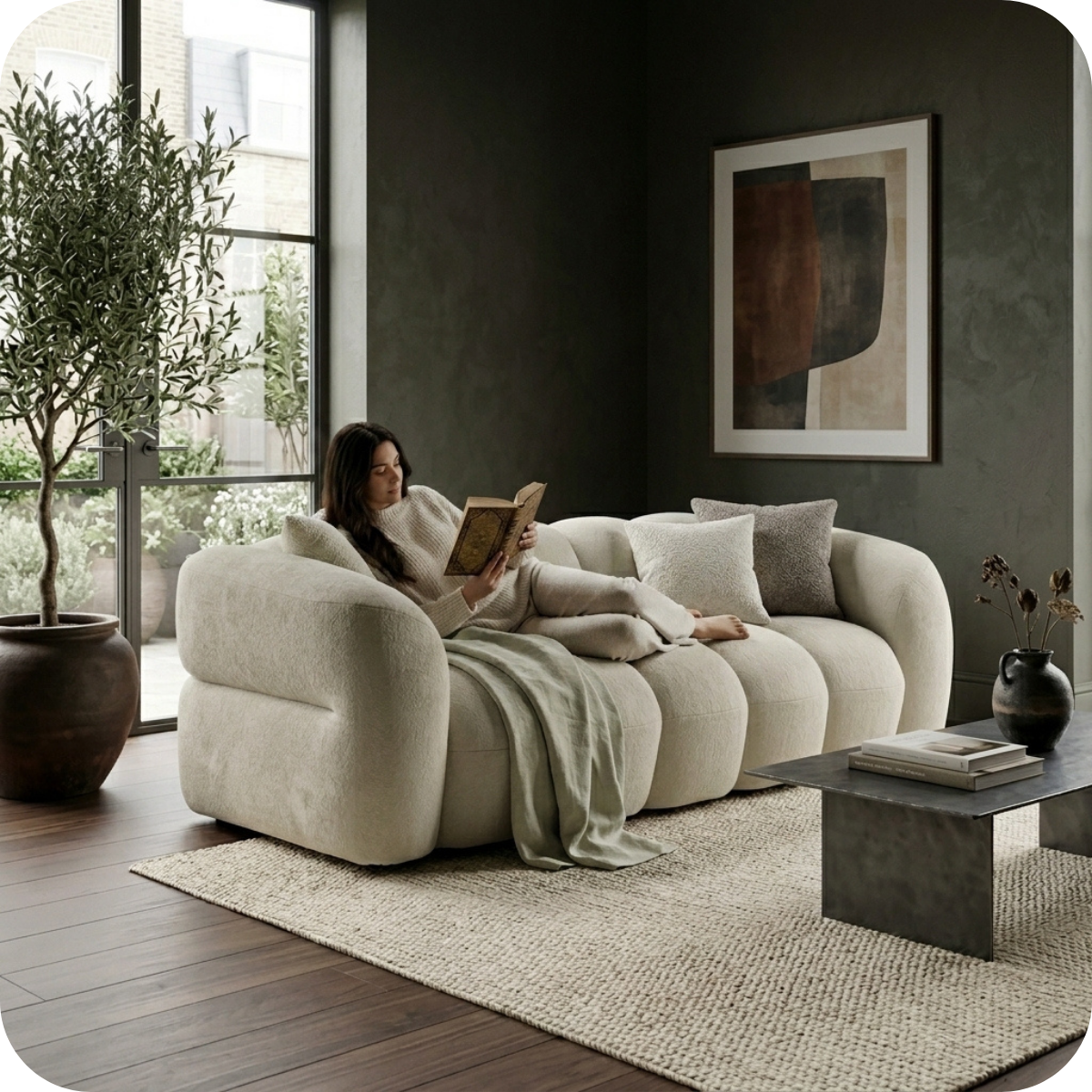
A Japandi living room is what happens when Japanese restraint meets Scandinavian warmth: low furniture, a palette borrowed from clay, linen and pale wood, nothing on display that does not earn its place – and yet the room feels welcoming rather than austere. It has been the most durable interior trend of the decade because it is less a look than a set of rules, and rules are easy to apply to the flat you already have. This guide covers the layout, the colour palette, the materials and, because the sofa is 70 per cent of a living room's visual weight, how to choose the right Japandi sofa.
Shop the look: browse our Japandi sofas – low MERLOT and PINOT, curved LUCCA in bouclé – made in Poland with free EU & UK delivery.
What Japandi actually means
The word is a portmanteau of Japan and Scandi. From Japan it takes wabi-sabi – beauty in imperfection and age – along with low seating, empty space (ma) and natural, unlacquered materials. From Scandinavia it takes hygge: softness, candlelight, wool, a room designed around sitting together through a long winter. The two traditions share a love of craft, functional shapes and light wood, which is why they blend so easily.
What distinguishes a Japandi interior from a plain Scandinavian one is tone and weight. Scandinavian rooms are white, bright and airy; Japandi rooms are warmer, slightly darker and more grounded, with black or charcoal accents and a lower horizon line. If you already like the Scandi look, our Scandinavian living room guide is the starting point; Japandi is the next step down in height and up in warmth.
Japandi living room layout: build it low and leave space
Most Japandi living rooms fail on layout, not on colour. Three principles fix that.
1. Lower the horizon
Japanese interiors are experienced close to the floor. Translate that with a sofa whose back is 65–72 cm high (a standard sofa is 85–95 cm), a coffee table at 30–38 cm, and art hung lower than you think – centre around 140 cm from the floor rather than the gallery-standard 150–155 cm. The result is more visible wall above the furniture, which makes even a small room feel taller and calmer.
2. One anchor, few companions
Choose a single sofa as the anchor and resist the second sofa. Add one armchair or a floor cushion, one coffee table, one side table. Each piece should have clear floor around it – you should be able to see the floor under and between furniture, which means slim legs or a floating base and no skirts.
3. Negative space is a feature
Leave one wall almost bare: a single branch in a ceramic vessel, a paper lantern, nothing else. Leave the top of the sideboard mostly empty. If the room feels unfinished, wait a week before adding anything – usually it stops feeling unfinished and starts feeling restful.
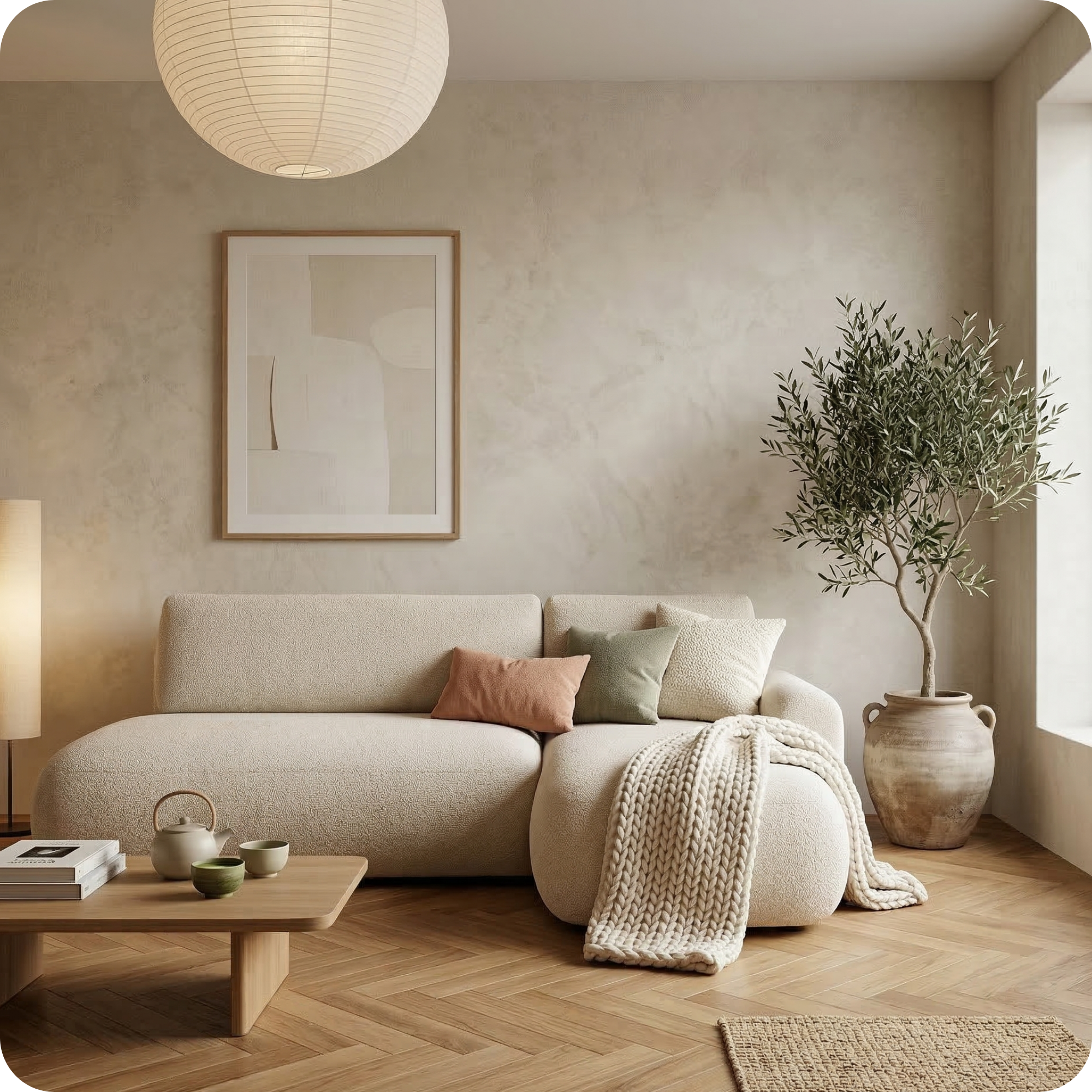
In a small flat this layout works especially well because it uses fewer, lower pieces. A 212 cm armless low sofa with a 35 cm oak table and a wool rug is a complete Japandi living room in 12 m².
The Japandi colour palette
Japandi colour is warm neutral with one or two grounding darks. Build it in layers:
| Layer | Colours | Where |
|---|---|---|
| Base (60%) | Warm white, limewash, oat, sand, greige | Walls, ceiling, large rug |
| Body (30%) | Pale oak, ash, taupe, stone grey, sage | Sofa, wood furniture, curtains |
| Grounding (10%) | Charcoal, black, dark walnut, deep forest green | One chair, lamp bases, picture frames, a single vase |
| Accent (a touch) | Terracotta, rust, ochre | A cushion, a ceramic bowl, a throw |
What to avoid: cool blue-greys and optic white, which pull the room back towards Scandinavian; high-gloss anything; and more than one accent colour. If you want a sofa that is not beige, sage green and dark forest green are the two shades that stay firmly inside the Japandi register – see our beige sofa styling guide for the neutral route and the sofa colour trends 2026 piece for where the palette is heading.
Materials and textures
Japandi is tactile. With so little colour contrast, texture does the work of keeping the room interesting:
- Wood: pale oak or ash for Scandi lightness, with one piece in dark walnut or black-stained oak for depth. Oiled, never lacquered.
- Textiles: linen curtains that puddle slightly, a wool or jute rug, a cotton or wool throw. On the sofa, bouclé and matte chenille both read as natural and handmade.
- Ceramics and stone: unglazed or matte-glazed vessels, a stone or travertine side table, a concrete planter.
- Paper and rattan: a paper pendant lamp, a rattan or cane chair seat, a woven basket for blankets.
- Plants: one sculptural specimen – an olive tree, a bonsai-trained ficus, a single branch of eucalyptus – rather than a jungle.
Metal is used sparingly and always matte: blackened steel, brushed brass. No chrome.

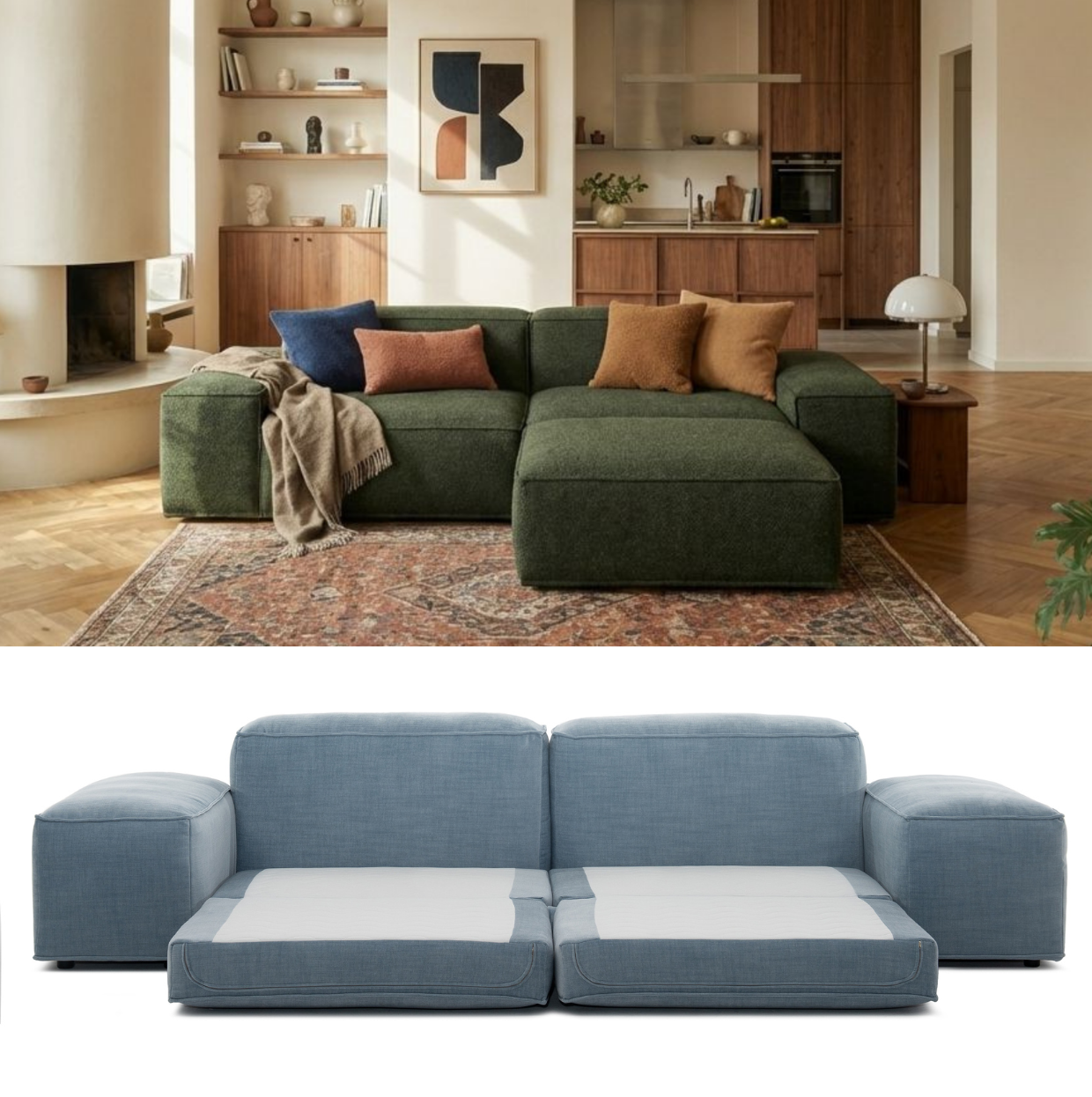
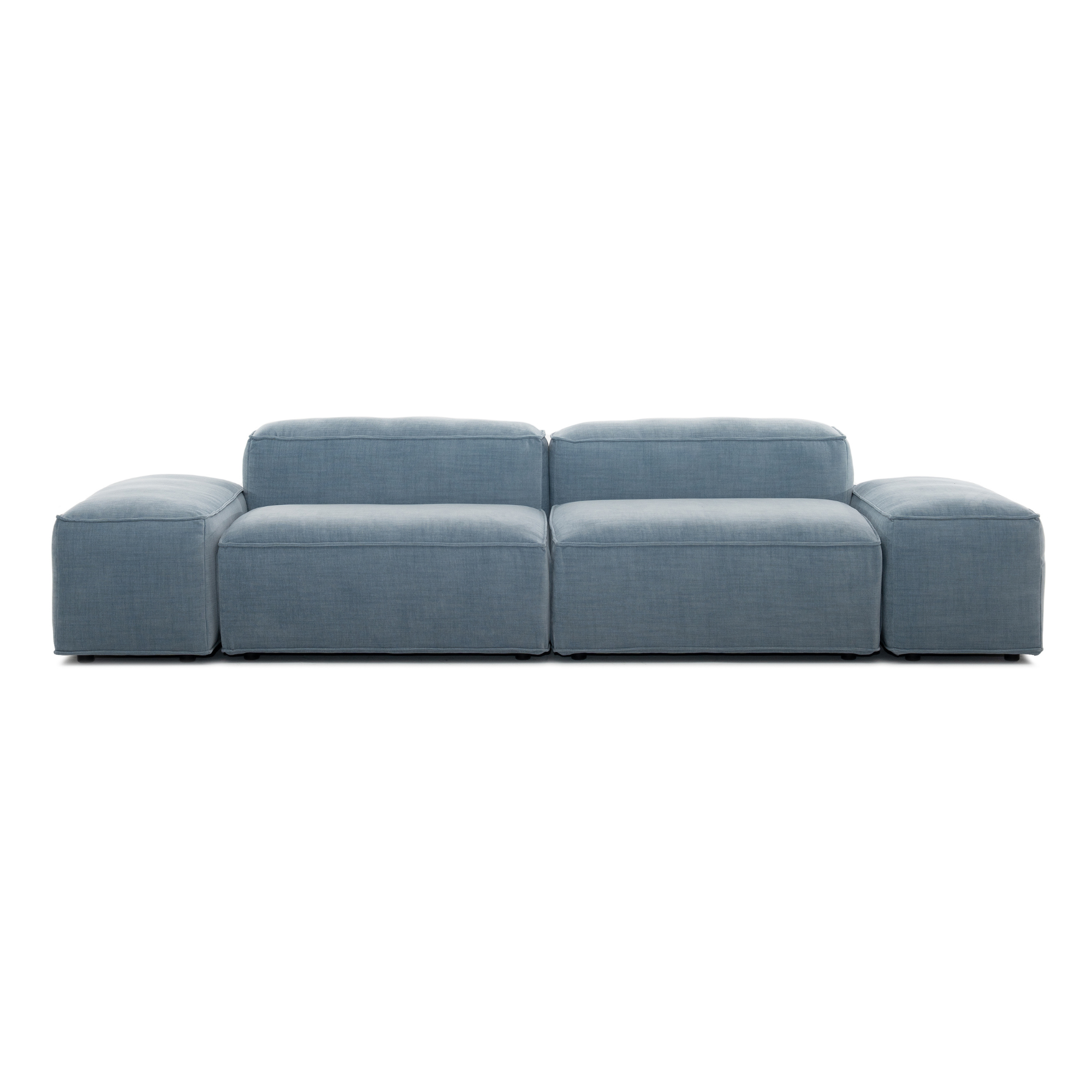
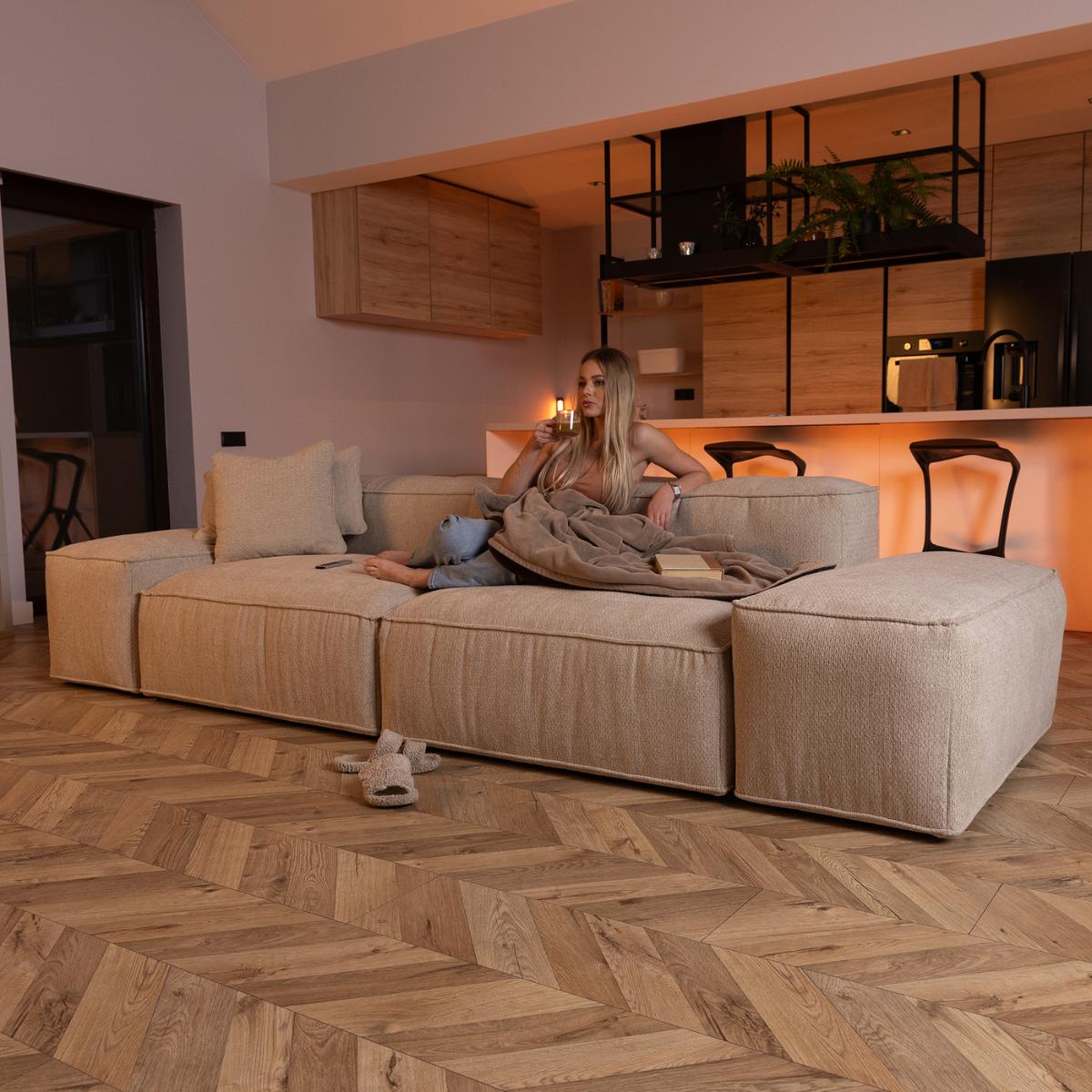
MERLOT Modular Sofa 3-Seater, Low Armrests — from €1,532
70 cm high with a deep 112 cm seat – the low horizon Japandi asks for. Beige and grey Retro Bliss chenille, taupe Rhythm, brown bouclé or dark green Golden chenille, HR foam and a hardwood frame. Add a chaise or extra seat later.

Japandi Sofas — from EUR 1
The Furni sofas that suit the style best: modular MERLOT at 70 cm, PINOT with a 67 cm back and 43 cm seat, and the curved LUCCA in bouclé – all in sand, greige, taupe, sage and forest tones. Free fabric samples.
Choosing the right Japandi sofa
A Japandi sofa has four traits: a low back (65–72 cm), a clean horizontal line without tufting or rolled arms, a natural-looking fabric in a warm neutral, and visible floor beneath or around it. The full breakdown is in our Japandi sofa guide; here is how Furni's models map onto those rules.
MERLOT – the low modular anchor
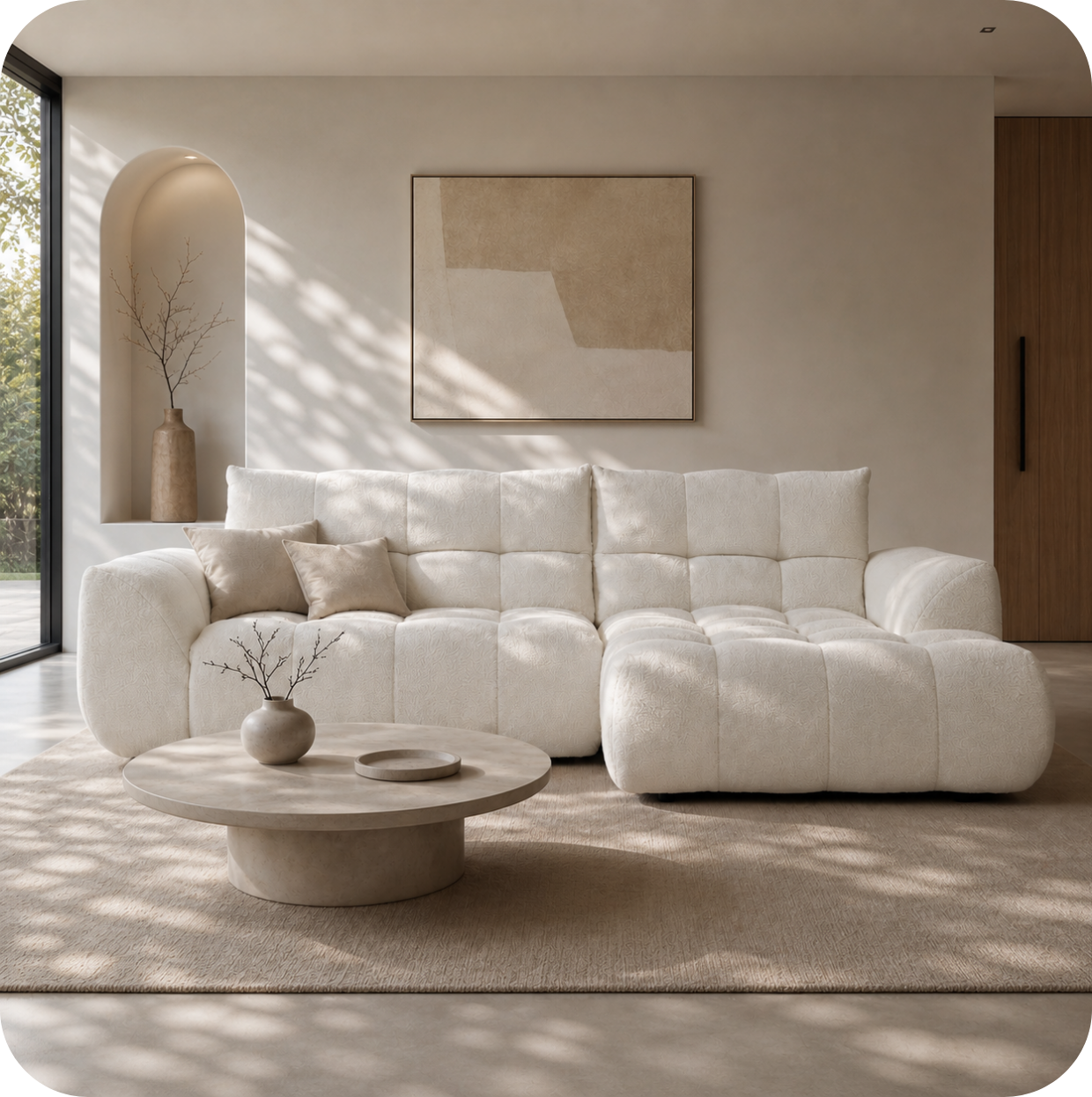
At 70 cm high MERLOT is the lowest full-size sofa in the range, and its deep seat invites the cross-legged, cushion-on-the-floor sitting Japandi rooms encourage. The armless 3-seater (212 × 111 cm) is the purest Japandi silhouette – a single horizontal block. With low arms it becomes 302 cm; with a longchair it turns into a low corner sofa without raising the horizon. Fabrics to choose: Retro Bliss 03 beige, Rhythm 108 taupe, Find Me 6 brown bouclé or Golden 35 dark green.
PINOT – the compact low sofa
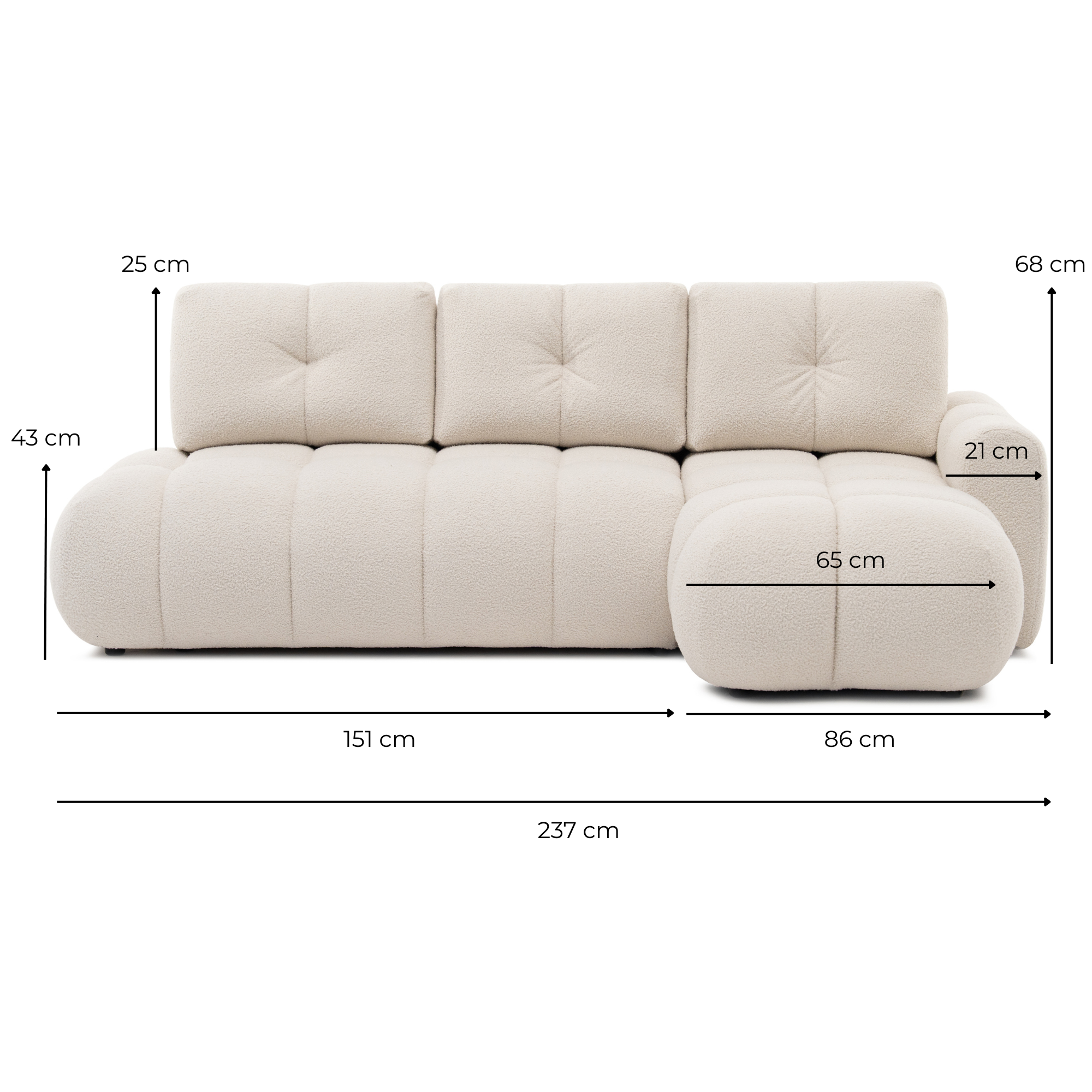
The PINOT 2-seater (190 × 95 cm, 67 cm high) is the Japandi choice for a small room – low, tidy and in beige, dark grey, navy or dark green Retro Bliss chenille. The PINOT 3-seater stretches to 262 cm with the same profile.
LUCCA – the soft, curved alternative
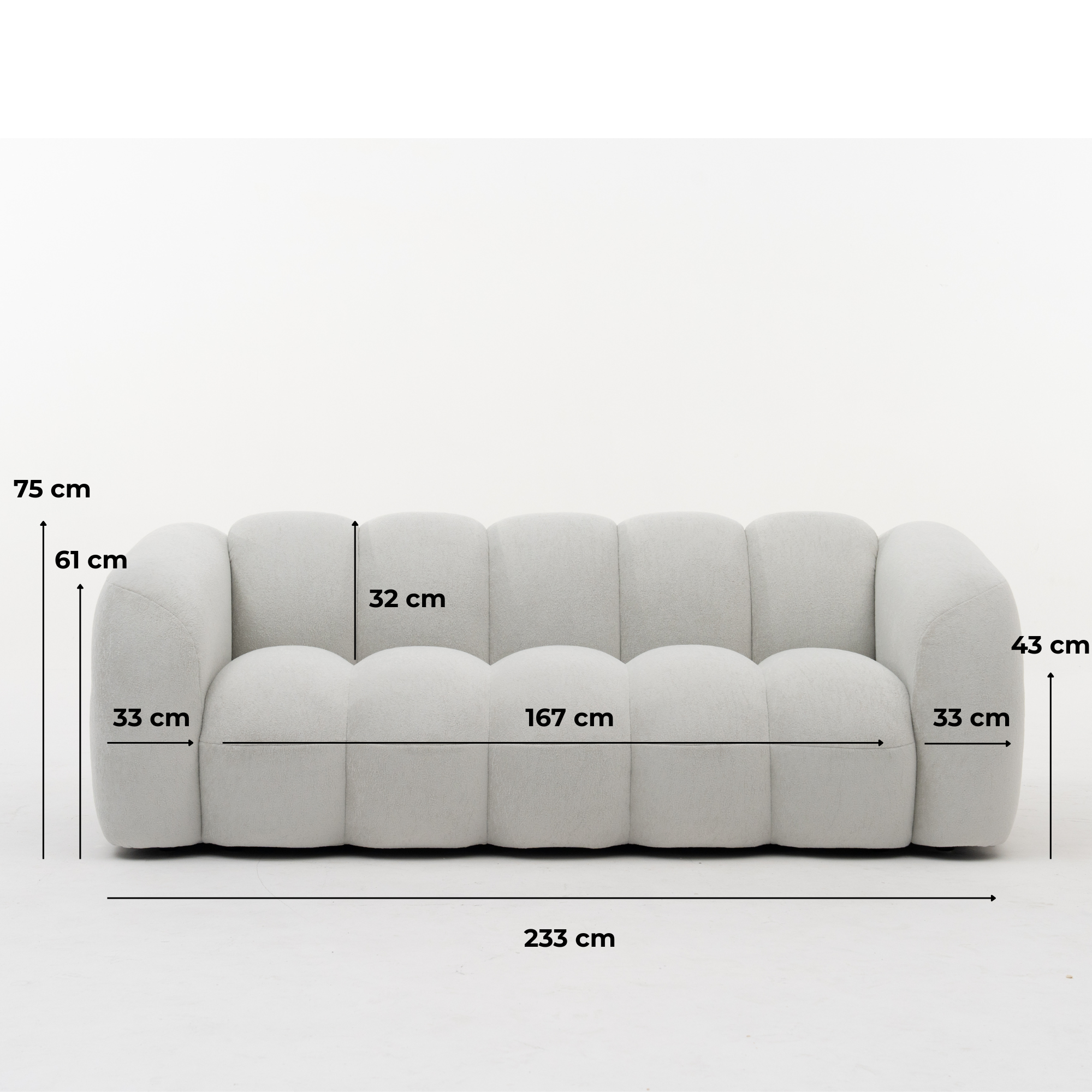
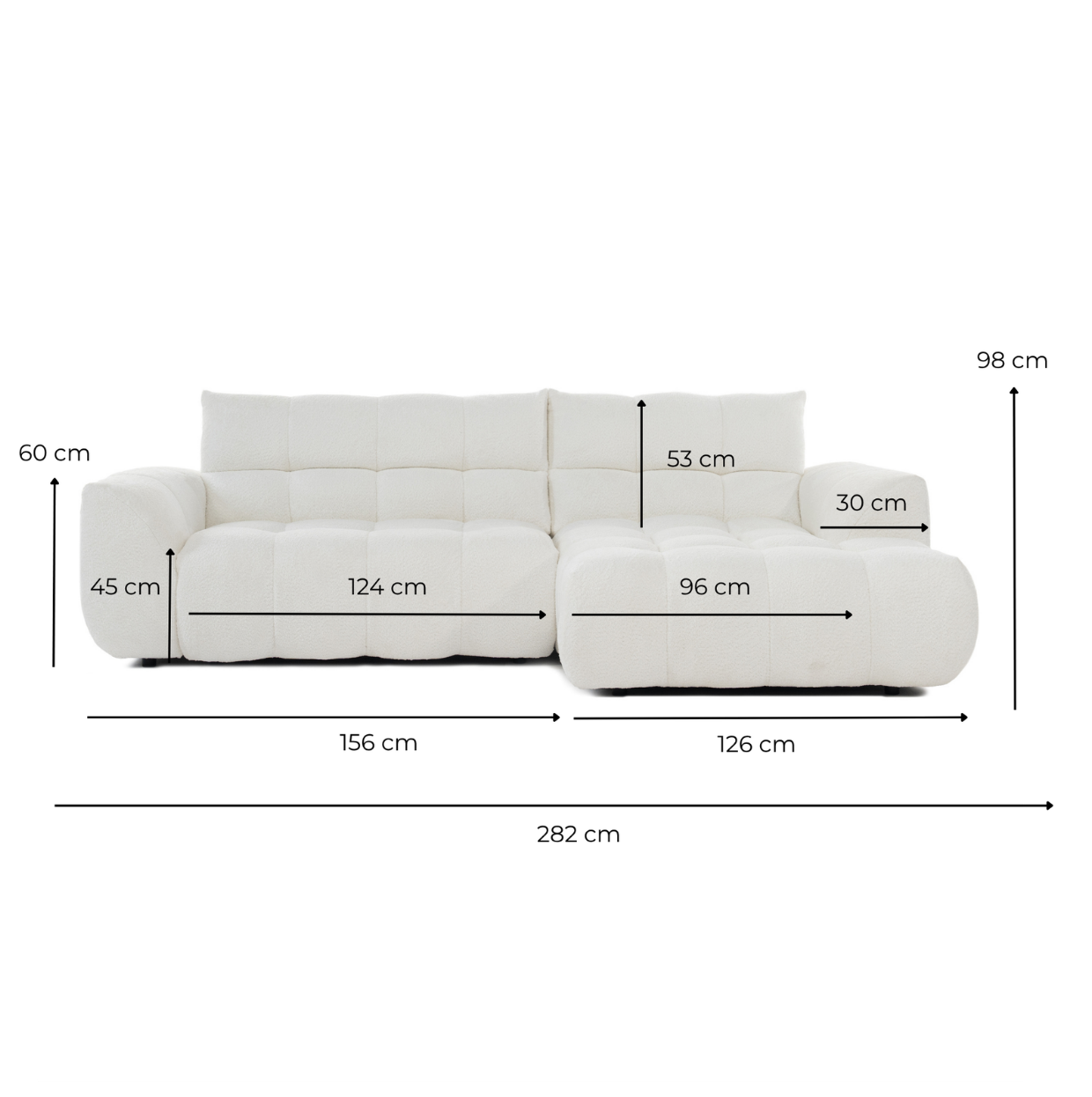
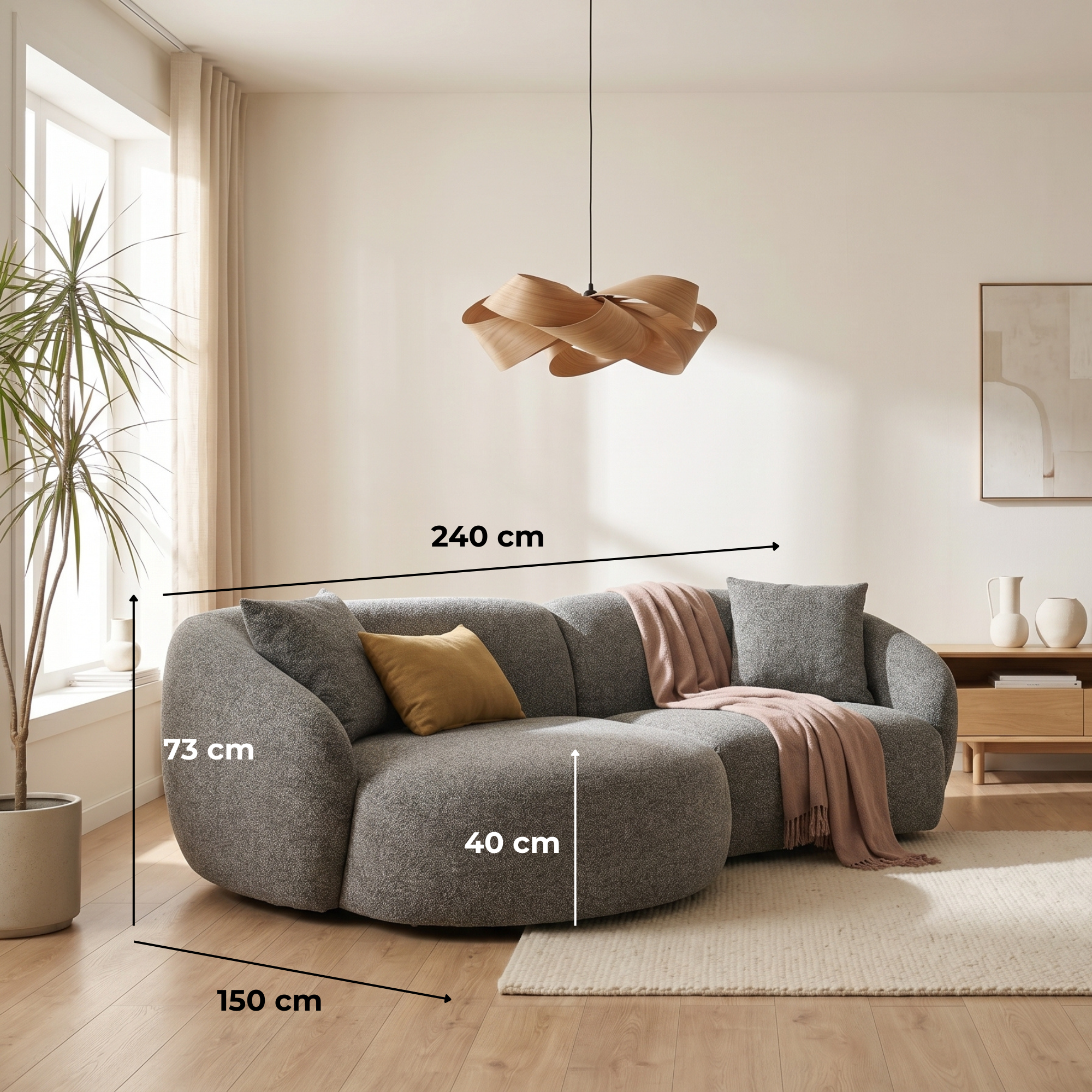
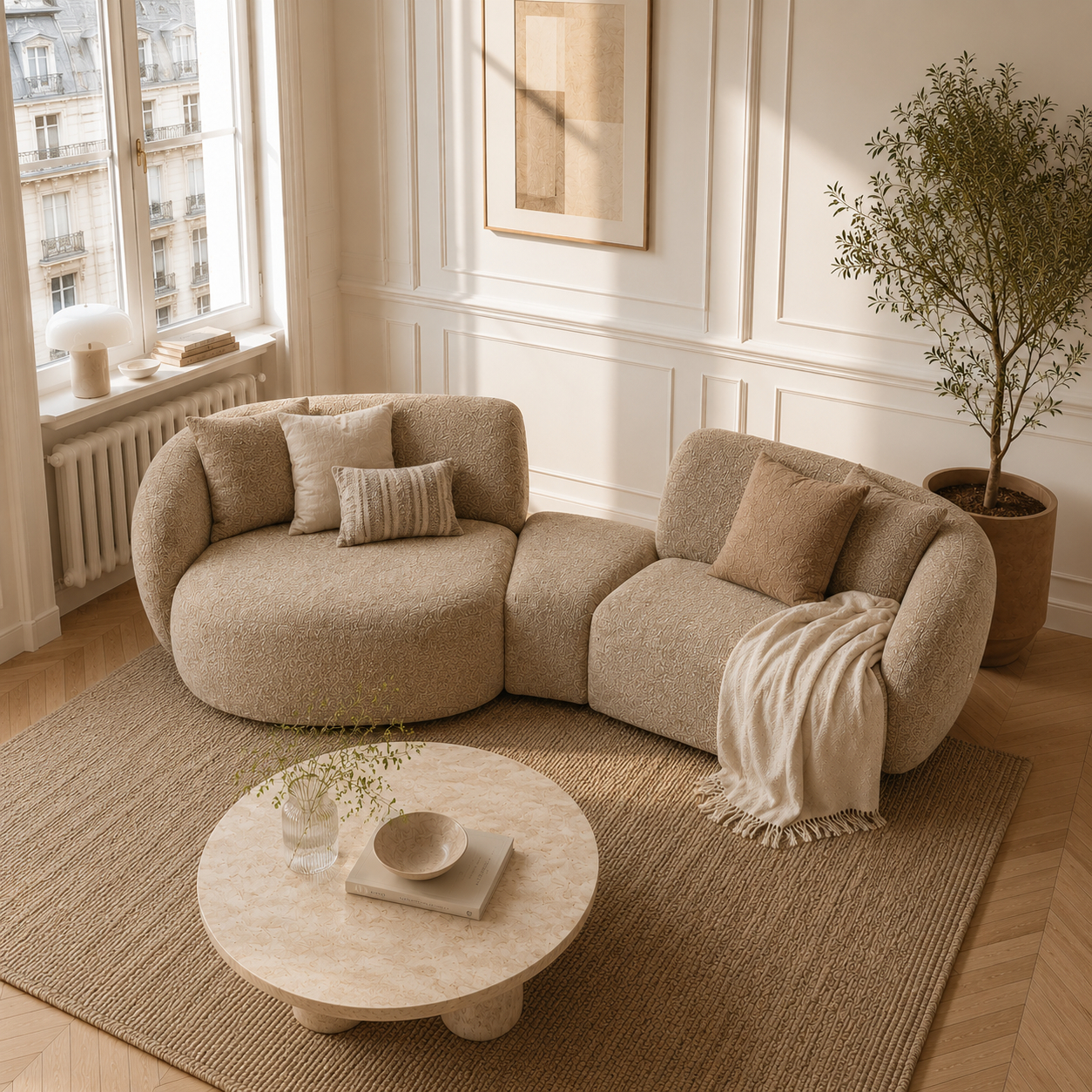
Japandi tolerates one organic shape, and the LUCCA 3-seater is it: 240 × 150 cm, 73 cm high, 40 cm seat, upholstered in dense Tana bouclé in cream beige, mélange grey, olive, taupe or terracotta. Pair it with straight-lined everything else so the curve stays the single soft note.
COMO – bouclé with a higher back
If 70 cm feels too low for how you sit, the COMO 3-seater (214 × 87 × 82 cm) in sage, cream or taupe Rhythm bouclé keeps the Japandi fabric story with a more supportive 82 cm back and a slim armrest option. Our bouclé sofa guide covers how the fabric wears.
Japandi living room ideas, room by room
- Small flat (10–14 m²): PINOT 2-seater or armless MERLOT against the longest wall, a 90 cm round oak table, a jute rug, one paper pendant. Nothing on the walls except one framed ink print.
- Open-plan living/dining: use the sofa back to divide zones – a low 70 cm back does this without blocking the room. Put the dark accent (a black-stained bench, a walnut sideboard) on the dining side.
- Family living room: a MERLOT longchair in dark green or taupe chenille, a wool rug large enough for floor play, closed storage in oak so toys disappear at night.
- Rented flat with dated finishes: Japandi is forgiving of imperfect floors and walls – that is the wabi-sabi part. A limewash-effect rug, linen curtains and a low sofa in sand will carry a room with a laminate floor.
How to create a Japandi living room: checklist
- Edit first: remove a third of what is in the room before buying anything.
- Paint walls a warm white or limewash tone, not optic white.
- Choose a low sofa (65–72 cm back) in sand, greige, taupe, sage or forest green with a natural-looking fabric.
- Add one dark grounding piece: a black chair, a walnut sideboard, a charcoal lamp.
- Layer textures – wool, linen, bouclé, ceramic, oiled wood – rather than colours.
- Keep lighting low and warm: a paper pendant, a floor lamp at seat height, candles.
- One plant, one vessel, one piece of art per wall.
- Buy the sofa to last: HR foam, a hardwood frame, OEKO-TEX fabrics and a real warranty – Furni offers 2 years, 30-day returns and free EU & UK delivery.
Frequently asked questions
What is Japandi style in a living room?
A hybrid of Japanese minimalism and Scandinavian cosiness: low furniture, warm neutral colours with a few dark accents, natural materials such as oak, linen, wool and ceramics, and deliberately empty space. The mood is calm and grounded rather than bright and busy.
What colours are used in a Japandi living room?
Warm whites, sand, oat and greige as the base; pale wood, taupe, stone grey and sage in the furniture; charcoal, black or dark walnut as grounding accents; and at most one earthy accent such as terracotta or ochre.
What is the best sofa for a Japandi living room?
A low sofa with a 65–72 cm back, straight lines and a natural-looking fabric in a warm neutral or muted green. At Furni that means MERLOT (70 cm) or PINOT (67 cm), or the curved LUCCA in bouclé if you want one organic shape.
Is Japandi the same as Scandinavian style?
No. Scandinavian rooms are whiter, brighter and higher; Japandi rooms are warmer, lower and darker, with black or charcoal accents and a stronger emphasis on imperfection and craft.
Does Japandi work in a small living room?
It works better in small rooms than most styles, because it relies on fewer, lower pieces and empty space. A low 2-seater, a small round table and a rug are a complete Japandi living room in 12 m².
Can I mix Japandi with what I already own?
Yes – keep any piece that is wooden, low, plain and in a warm neutral; remove or recover anything glossy, patterned or tall. Most people only need to change the sofa, the lighting and the textiles.
Made in Poland · Free EU & UK delivery · Free fabric samples · 30-day returns · 2-year warranty · Trustpilot 4.8